
World
US Strikes Iran's Qeshm Island After Third Drone Attack on Bahrain Base
US jets struck an IRGC missile site on Qeshm Island after Tehran's third drone attack on US targets in Bahrain in five days, as a third US carrier arrives.
Drafted with the help of AI tools and reviewed by our editor. Read our editorial policy.
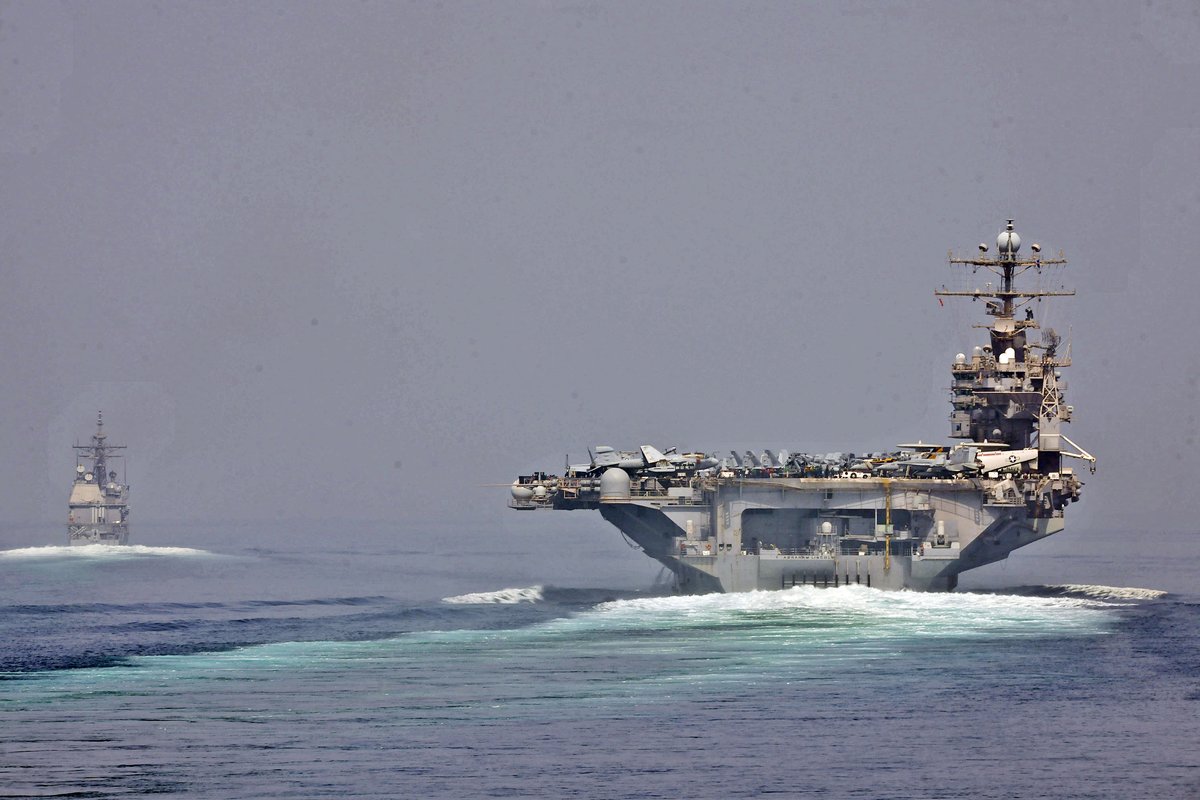
TL;DR — the direct answer: The United States military has disabled another merchant ship that tried to run its naval blockade of Iranian ports. A US military aircraft fired precision munitions at the stern of the Palau-flagged M/V Pacific Archer on Thursday, 26 November 2026, in the Gulf of Oman, disabling the bulk carrier's propulsion, US Central Command said on Friday. The civilian crew was unharmed. According to Central Command, the ship had left the Iranian port of Bandar Abbas before it attempted to run the blockade, despite multiple warnings, and ship tracking websites list its destination as Singapore. It is at least the 15th vessel the US military has publicly acknowledged disabling since the blockade began in April, and the sixth since the blockade resumed in July after a pause during talks with Tehran. The previous vessel was disabled on 7 November. The strike came as Iran vowed to confront the blockade: an adviser to Supreme Leader Ayatollah Mojtaba Khamenei said Iran would keep the Strait of Hormuz shut while breaking the embargo, and the commander of the Iranian navy said Iran would carry out operations to break the blockade and drive the enemy out of the region's waters. The episode underlines how the confrontation over Iranian shipping has become a slow-burning naval campaign, fought ship by ship, with the United States maintaining a constant presence of two aircraft carriers in the region.
| Metric / Date | Key Detail | Source |
|---|---|---|
| 26 Nov 2026 | US aircraft fire precision munitions at the stern of M/V Pacific Archer in the Gulf of Oman | Reuters |
| The ship | Palau-flagged bulk carrier; left Bandar Abbas, bound for Singapore; propulsion disabled, crew unharmed | Military.com |
| Blockade tally | 158 ships redirected; 15th vessel disabled since April, 6th since the blockade resumed in July | Al Jazeera |
| Previous vessel | Last vessel disabled on 7 November 2026 | Military.com |
| Iran response | Supreme leader's adviser says Iran will keep the Strait of Hormuz shut and break the embargo | Reuters |
The US military said on Friday, 27 November 2026, that it had disabled a commercial ship on Thursday after the vessel attempted to run the American blockade of Iran. A military aircraft launched precision munitions that struck the stern of the Palau-flagged M/V Pacific Archer in the Gulf of Oman, and the ship's propulsion was ultimately disabled while the civilian crew was unharmed, US Central Command said in a statement. According to Central Command, the M/V Pacific Archer left the Iranian port city of Bandar Abbas before it attempted to run the blockade, despite multiple warnings, and ship tracking websites list the vessel's destination as Singapore. Central Command has consistently said that American forces issue multiple warnings before firing on merchant ships, and the statement said the crew had been warned repeatedly. The strike was announced on Central Command's official account, which posted that the crew attempted to run the US naval blockade despite multiple warnings following departure from Bandar Abbas. The Pacific Archer is a bulk carrier, and it is at least the 15th vessel the US military has publicly acknowledged disabling since the blockade began in April, and the sixth since it resumed in July. The previous vessel was disabled on 7 November. US forces have redirected 158 commercial vessels that complied with blockade instructions, and disabled six that refused to comply since the resumption.
The incident is trending because it is the latest shot in a confrontation that has been escalating for months, and because both sides used it to stake out maximal positions on the same day. Within hours of the strike, Mohammad Mokhber, an adviser to Iran's Supreme Leader Ayatollah Mojtaba Khamenei, said: neither will the Strait of Hormuz be reopened, nor will we allow the blockade to remain in place, according to Iranian state media. He did not give details of Iran's plans for breaking the embargo. The commander of the Iranian navy, Shahram Irani, went further on state television, saying Iran would carry out operations that will not only break the naval blockade but also drive the enemy out of the region's waters. The timing matters. The strike comes as the Trump administration weighs its options in the long-simmering war with Iran, which began at the end of February and has settled into a quiet stalemate in the past several months. Earlier in November, officials in the region told the Associated Press that Israeli Prime Minister Benjamin Netanyahu was pushing the United States to restart the war or allow Israel to launch airstrikes on Iran's nuclear facilities and missile capabilities. Meanwhile, government and security officials from the Persian Gulf countries, as well as Pakistan and Turkey, have been engaged in a diplomatic campaign, including phone calls with senior US officials, to stave off a renewed war. President Donald Trump has oscillated between threatening additional large-scale strikes against Iran and insisting that the war militarily is effectively over. Each disabled ship is therefore read twice: as an enforcement action, and as a signal about whether the stalemate holds.
The United States has been blockading Iranian ports since April 2026, although the blockade was temporarily lifted during talks with Tehran in the summer and resumed in July. Earlier this month the US announced Task Force Iron Gate, a new effort to restrict the movement of weapons and sanctioned materials across Iran's land borders and the Caspian Sea, widening the campaign beyond the sea. The US military has maintained a sizeable naval force in the region, including a constant presence of two aircraft carriers and a host of other ships, and Central Command, which has its headquarters in Florida, oversees the operation. The blockade is aimed at Iranian oil exports, and it is biting: oil flows in the first two weeks of November fell by around 20 percent to around 13 million barrels per day compared with October, when exports roughly equalled the prewar amounts of 15 to 16 million barrels per day, according to Rystad Energy. The reasons for the decline include Iranian attacks that discourage tankers from attempting the strait crossing and reduced flows through a key Saudi pipeline to the Red Sea port of Yanbu, which has also been attacked several times. The campaign has not been bloodless. In June, the practice drew condemnation when a military strike on a Guinea-Bissau-flagged tanker attempting to evade the American blockade resulted in three deaths, and three Indian sailors were killed when American forces struck the Palau-flagged tanker Settebello. The leader of the International Maritime Organization, a United Nations agency, condemned that attack. The pattern since then has been consistent: warnings, then precision fire at the stern to disable propulsion, with the crew left unharmed. The Islamic Revolutionary Guard Corps said on Friday that two tankers attempted to transit the Strait of Hormuz through an unauthorised route, claiming that one of them struck a naval mine while the other was forced to turn back, but those claims could not be independently verified.
Confirmed: a US military aircraft fired precision munitions at the stern of the Palau-flagged M/V Pacific Archer on Thursday, 26 November, in the Gulf of Oman, disabling the ship's propulsion while the civilian crew was unharmed; the ship had departed the Iranian port of Bandar Abbas and was bound for Singapore, according to ship tracking websites; Central Command said the crew attempted to run the blockade despite multiple warnings; the Pacific Archer is at least the 15th vessel publicly acknowledged as disabled since the blockade began in April and the sixth since it resumed in July, with the previous vessel disabled on 7 November; US forces have redirected 158 merchant ships that complied with blockade instructions; the US reimposed the blockade in July and announced Task Force Iron Gate earlier in November; and Mokhber said Iran would keep the Strait of Hormuz shut while vowing to break the embargo, while the Iranian navy commander said Iran would carry out operations to break the blockade. The US has been blockading Iranian ports since April, with a pause during talks in the summer, and the war with Iran began at the end of February and has settled into a quiet stalemate. What remains unconfirmed is what the Pacific Archer was carrying, and whether it was carrying sanctioned cargo at all: Central Command's statement does not say, and no manifest has been published. It is also unconfirmed whether the vessel will be boarded, towed or left disabled in the Gulf of Oman, and what happens to its crew. The claims by the Islamic Revolutionary Guard Corps that two tankers tried to transit the Strait of Hormuz through an unauthorised route, that one struck a naval mine and the other turned back, could not be independently verified, and the Guard also said the number of oil tankers attempting to transit through unauthorised routes has sharply decreased in recent days, a claim that also cannot be checked. Iran's threat to break the embargo comes with no stated plan, and Mokhber gave no details.
The immediate question is what happens to the Pacific Archer. A disabled bulk carrier in the Gulf of Oman, with its crew aboard and its propulsion gone, has to be dealt with: towed, boarded, or left adrift under watch, and Central Command has said nothing yet about which it will be. The wider question is whether the pattern holds or breaks. The United States has now disabled six vessels since the blockade resumed in July, roughly one a month, and each one has followed the same script: warnings, precision fire at the stern, crew unharmed. If Tehran follows through on its vow to break the embargo, the next attempt could look very different: an escorted transit, a naval escort through the Strait of Hormuz, or a direct confrontation between Iranian and American naval forces, which the Iranian navy commander appeared to threaten on Friday. The diplomatic track runs in parallel. Gulf states, Pakistan and Turkey are pressing Washington to avoid a renewed war, while Netanyahu is pressing in the opposite direction, and Trump has swung between threatening new strikes and declaring the war effectively over. The oil market will be watching too: flows already fell by about a fifth in early November, and a further escalation in the strait, through which a large share of the world's seaborne oil passes, would push prices higher. A report by UN Trade and Development already finds that disruptions in the Strait of Hormuz, the Red Sea, the Black Sea and the Panama Canal are lengthening voyages, raising fuel costs and driving port congestion. For now, the stalemate holds, but each disabled ship narrows it a little further, and the strikes on Qeshm Island earlier in the conflict showed how quickly a standoff at sea can become a shooting war.
Q: What happened to the M/V Pacific Archer?
A: A US military aircraft fired precision munitions at the stern of the Palau-flagged bulk carrier M/V Pacific Archer on Thursday, 26 November 2026, in the Gulf of Oman, disabling the ship's propulsion. The civilian crew was unharmed. US Central Command said the ship had left the Iranian port of Bandar Abbas and attempted to run the American blockade of Iranian ports despite multiple warnings, and ship tracking websites list its destination as Singapore.
Q: What is the US blockade of Iran?
A: The United States has been blockading Iranian ports since April 2026, aiming to stop Iranian oil exports and the movement of sanctioned materials. The blockade was temporarily lifted during talks with Tehran in the summer and resumed in July. Earlier in November the US announced Task Force Iron Gate to restrict weapons and sanctioned materials across Iran's land borders and the Caspian Sea as well. The US maintains two aircraft carriers in the region.
Q: How many ships has the US disabled in the blockade?
A: The Pacific Archer is at least the 15th vessel the US military has publicly acknowledged disabling since the blockade began in April, and the sixth since it resumed in July. The previous vessel was disabled on 7 November. US forces have also redirected 158 commercial vessels that complied with blockade instructions. In June, a strike on a Guinea-Bissau-flagged tanker killed three people, and three Indian sailors were killed when US forces struck the tanker Settebello.
Q: Was anyone hurt in the Pacific Archer strike?
A: No. US Central Command said the civilian crew was unharmed. The munitions struck the stern of the ship, disabling its propulsion rather than sinking the vessel. Central Command says American forces issue multiple warnings before firing on merchant ships. The US has said the same about previous disablements, though the June strikes on two tankers did kill crew members.
Q: How has Iran responded to the blockade?
A: An adviser to Supreme Leader Ayatollah Mojtaba Khamenei, Mohammad Mokhber, said Iran would keep the Strait of Hormuz shut while vowing to break the embargo, though he gave no details of how. The commander of the Iranian navy, Shahram Irani, said on state television that Iran would carry out operations to break the naval blockade and drive the enemy out of the region's waters. Iran's Revolutionary Guard also said two tankers tried to transit the strait through an unauthorised route on Friday, claiming one struck a naval mine, but that could not be independently verified.
Sources: Reuters - US disables ship trying to leave Iran, as Tehran vows to confront blockade, Al Jazeera - US military says it disabled merchant ship trying to breach Iran blockade, Military.com (Associated Press) - US Military Says It Disabled Another Ship that Tried to Breach Naval Blockade on Iranian Ports, and The Hindu - U.S. disables ship trying to leave Iran, as Tehran vows to confront blockade.
US jets struck an IRGC missile site on Qeshm Island after Tehran's third drone attack on US targets in Bahrain in five days, as a third US carrier arrives.

Iran widened its attacks to Kuwait on Wednesday, firing drones at Ali Al Salem Air Base and again at Bahrain, a day after US jets struck Qeshm Island.

Focker In-Law took $7.7 million on Thanksgiving Day for second place, behind the Hunger Games prequel's $11.6 million, as Ariana Grande joined the cast.
The day’s biggest stories in your inbox every morning — free, no spam, unsubscribe anytime.