
Netflix Leads Bidding for US Rights to the 2030 World Cup as FIFA Opens Second Round
Netflix has submitted the highest opening bid for US rights to the 2030 World Cup, ahead of Amazon and a joint Fox-Univision bid, as FIFA seeks up to $2bn.

By Toijam Bimoljit Singh • 26 November 2026 • 9 min read
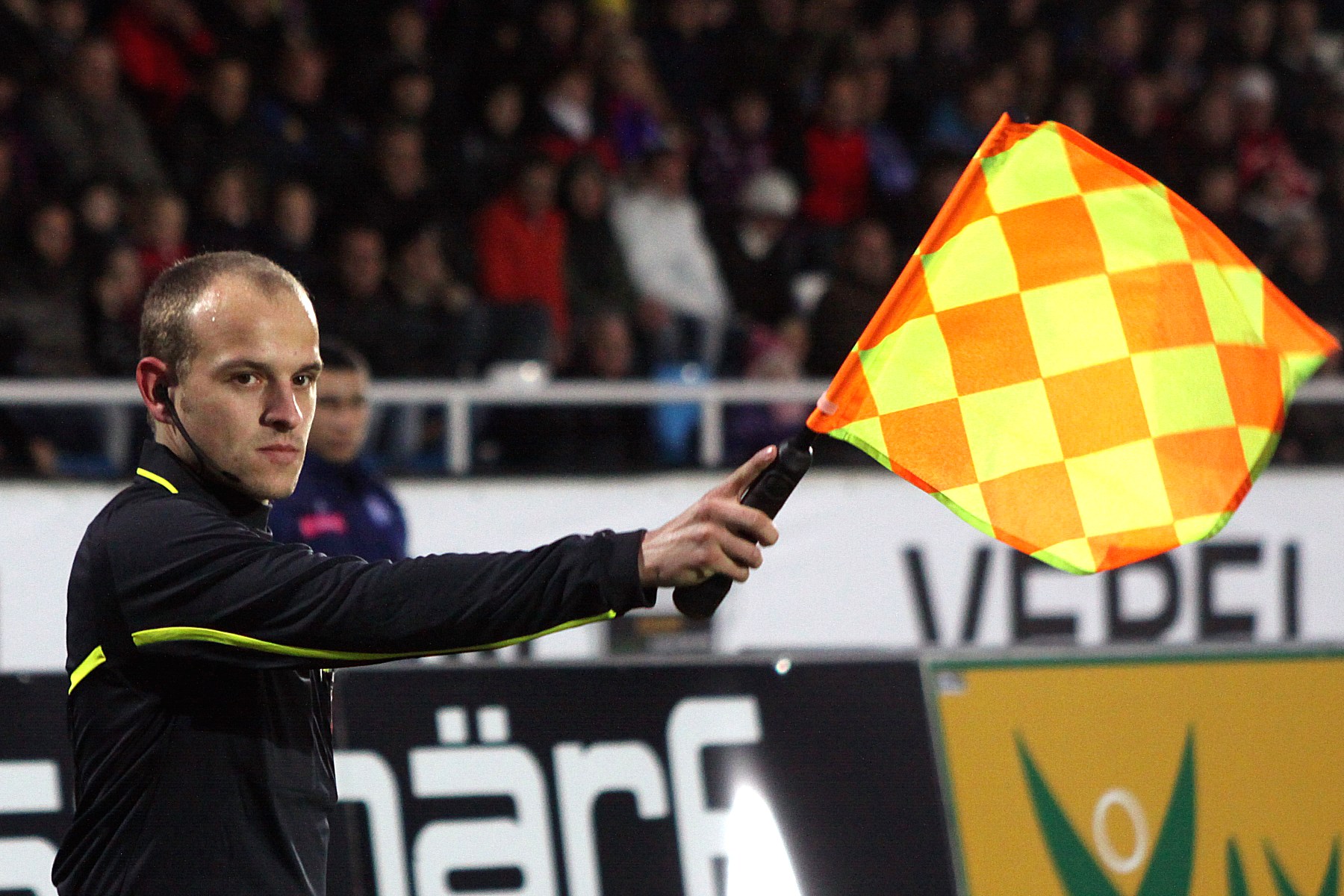
Photo: Steindy / Wikimedia Commons — assistant referee Clemens Schüttengruber signalling offside.
TL;DR — the direct answer: Offside is three checks, not one. First, the picture: at the moment a team-mate plays the ball, is any part of the attacker's head, body or feet nearer the goal than both the ball and the second-last opponent? If not, play on — and level is onside. Second, standing there is not an offence on its own: the player has to touch the ball, interfere with an opponent, or profit from a rebound or a save. Third, the exceptions: no offside in your own half, and none at all from a goal kick, corner or throw-in. VAR and semi-automated offside, in use in the Premier League since April 2025, only measure that same picture faster — they did not change the law. And the law nearly did change: Arsène Wenger's 'daylight' version, trialled in Canada in 2026, cut offsides by 54% but barely added goals, because defences just dropped deeper — so the old rule survives, for now.
The one picture to remember: Forget the arguments and keep one picture in your head. When a team-mate plays the ball forward, freeze the frame at that exact instant. Draw a line through the second-last opponent — almost always the last outfield defender, because the goalkeeper is usually the last one — and another through the ball. If any part of the attacker that can legally score — head, body or feet — is nearer the goal than both of those lines, they are in an offside position. Hands and arms never count, for anyone, including the goalkeeper; the arm starts at the bottom of the armpit, so a shoulder can be offside but a hand cannot. Three things about that picture matter more than the rest. First, it is judged at the moment the ball is played, not when the attacker receives it — a player who was onside when the pass was hit can run past every defender and still score legally. Second, level is onside: if the attacker is exactly in line with the second-last opponent, or with the ball, there is no offside. That has been the law since 1990, when IFAB changed it to favour attackers. Third, being behind the ball is always safe — that is why cut-backs across the face of goal, where the passer rolls it backwards to a team-mate, can never be offside no matter how far forward that team-mate is standing.
Position is not an offence — until it is: This is the part most arguments miss. Standing in an offside position is not an offence at all — the Laws of the Game say so in the first line of Law 11. It only becomes an offence if the player then gets involved, in one of three ways. One: interfering with play — touching or playing a ball passed by a team-mate. Two: interfering with an opponent — clearly blocking the goalkeeper's or a defender's line of vision, challenging an opponent for the ball, clearly trying to play a nearby ball in a way that affects an opponent, or making an obvious action that clearly affects an opponent's ability to play the ball. Standing near the goalkeeper is not enough on its own; the block has to be clear, and it has to matter. Three: gaining an advantage — playing the ball after it rebounds or is deflected off the post, the crossbar, the referee or an opponent, or after an opponent has deliberately saved it. There is also a reset that decides plenty of close calls: if an opponent deliberately plays the ball — a pass, a clearance, even one that goes wrong — the attacker is onside again, no matter where they were standing. The one exception to the reset is a deliberate save: if a defender stops a ball heading for goal and it falls to an offside attacker, that is still offside. And if an offside offence does happen, the punishment is small and specific: an indirect free kick to the defending team from where the offence occurred — no card, however often it happens.
The three times offside can never happen: There are three restarts where the rule simply does not apply, and they are worth memorising because they explain goals that look wrong. You cannot be offside receiving the ball directly from a goal kick, a corner kick, or a throw-in — the law lists all three, and it is why teams can crowd the box at a corner without anyone worrying about the line. You also cannot be offside in your own half: a player has to have some part of their head, body or feet in the opponents' half to be in an offside position at all, and standing on the halfway line itself does not count. And as above, you cannot be offside if you are level with the second-last opponent, or behind the ball when it is played. Put together, those three exceptions cover most of the 'how was that not offside?' moments: the winger who collects a throw-in behind the defence, the striker who starts his run from his own half, and the tap-in from a cut-back are all legal by design, not by a referee's mistake.
Why VAR made it feel worse: Offside used to be a linesman's instant flag. Now the flag stays down on tight calls until the attack ends — deliberately, so a goal can be checked rather than wrongly stopped — and then the VAR room measures the frozen frame. That delay is why goals are celebrated, checked, and sometimes ruled out minutes later, and why the arguments got louder: the law did not change, but every marginal call is now measured to the centimetre on television. Since April 2025 the Premier League has used semi-automated offside technology to do the measuring: up to 30 cameras around the stadium, some at 100 frames a second, tracking the ball and up to 10,000 points on each player's body. The system suggests the kick-point — the exact moment the ball was played — and draws the lines itself, then a human VAR checks it before the 3D decision graphic goes to the stadium screens and the broadcast. It makes the decision about 30 seconds faster, according to the league; it does not change what counts as offside. One small thing did change in the 2025-26 laws: the kick-point is the first contact with the ball, except when the goalkeeper throws it, when the last point of contact (the release) is used instead — because a throw has no single clean first contact to measure.
Background / a short history: The rule started as the strictest version imaginable. In the FA's first laws, in 1863, any player in front of the ball was out of play and had to get back behind it — goal-hanging was treated as unsporting, and the point was to force dribbling and short passes. In 1866 it softened to the three-player rule: an attacker was onside if three opponents stood between them and the goal. In 1907 players stopped being offside in their own half. The big one came in 1925, when the three-player rule became two: Football League goals jumped from 4,700 to 6,373 in a single season, teams stretched out, and the W-M formation was born. Level became onside in 1990, and in 2005 IFAB wrote in the body-parts rule — head, body or feet count, arms do not. Every change in that list pulled the same way: more goals, more attacking, fewer stoppages. That is the pattern to keep in mind when the next proposed change arrives.
What we know / what's unconfirmed: Confirmed: the law as written above, the 2025-26 goalkeeper-throw clarification, and the semi-automated system now running in England. Confirmed too: Wenger's 'daylight' trial happened, and its numbers — 108 Canadian Premier League matches in the 2026 season, offside decisions down 54%, defences dropping one to three metres deeper, only 13 goals from positions that would have been offside under the current law. Unconfirmed: the final verdict. The Times (18 November 2026) and Inside World Football (28 October 2026) both report that IFAB's advisory panels are expected to recommend against adoption, and that even Wenger has doubts about the results — but no official decision has been announced, and a law change still needs six of IFAB's eight votes at the annual meeting in spring. What is also still open is the alternative Wenger may push instead: judging offside only by a player's torso, rather than feet and legs. Until IFAB votes, the law in this article is the law in force.
What happens next: Watch the next game with the three checks in mind and the rule stops looking random. First, find the second-last opponent as the pass is played — that is the line that matters, not the goalkeeper alone. Second, wait for the involvement: a player standing offside while the ball goes elsewhere has done nothing wrong, and the flag only matters when they touch it or affect a defender. Third, expect the delay on tight goals: the assistant keeps the flag down, VAR measures, and the 3D graphic shows the line. The law itself is not about to change — the daylight experiment's failure makes that unlikely for 2027-28 — so the arguments will stay where they have always been: not about what the rule says, but about a shoulder, a toe, and a single frozen frame.
Q: What is offside in football, in simple terms?
A: A player is in an offside position if, at the moment a team-mate plays the ball, any part of their head, body or feet is in the opponents' half and nearer the goal than both the ball and the second-last opponent. But that position alone is not an offence — they are only penalised if they then touch the ball, interfere with an opponent, or gain an advantage from a rebound or a save.
Q: Can you be offside from a throw-in, corner or goal kick?
A: No. The law says there is no offside offence if a player receives the ball directly from a goal kick, a throw-in or a corner kick. You also cannot be offside in your own half, or if you are level with the second-last opponent, or behind the ball when it is played.
Q: Why do linesmen wait so long to raise the flag now?
A: In VAR matches, assistant referees are told not to flag a tight offside until the attack reaches a natural conclusion, unless it is obvious. That way a goal can be checked by VAR instead of being wrongly stopped early. The delay is the system working as designed, not indecision.
Q: Is the offside rule about to change?
A: Not for now. Arsène Wenger's 'daylight' version — offside only when there is clear daylight between attacker and defender — was trialled in the Canadian Premier League in 2026. Offsides fell 54%, but defences just dropped deeper and only 13 extra goals resulted, so IFAB's advisory panels are expected to recommend against adopting it. No final official decision has been announced, and any change needs six of IFAB's eight votes.
Sources: IFAB — Laws of the Game, Law 11: Offside (primary source for the law), The FA — Law 11: Offside, Laws of the Game 2025/26, The FA — Changes to the Laws of the Game 2025/26 (goalkeeper-throw clarification), Wikipedia — Offside (association football) (law text, history: 1863, 1866, 1907, 1925, 1990, 2005; VAR flag delay), Premier League via OneFootball — Semi-automated offside technology, official release 11 April 2025 (debut 12 April 2025, 30 cameras, 100fps, 10,000 mesh points), The FA — How semi-automated offside technology works (FA Cup debut 28 Feb 2025), The Times — Arsène Wenger's 'daylight' offside proposal set to be shelved (18 Nov 2026; 108-match Canadian trial, -54% offsides, 13 extra goals), Inside World Football — IFAB go cold on Wenger's offside proposal after Canadian Premier League test (28 Oct 2026), Bundesliga — The offside rule in soccer clearly explained, and Sports Illustrated — The Offside Rule in Soccer Explained.

Netflix has submitted the highest opening bid for US rights to the 2030 World Cup, ahead of Amazon and a joint Fox-Univision bid, as FIFA seeks up to $2bn.
25 November 202610 min read

FIFA has confirmed the US, Mexico, Costa Rica and Jamaica as hosts of the 2031 Women's World Cup, the first with 48 teams, and the UK for 2035.
24 November 20269 min read