Spain Grinds to a Halt in Its First General Strike in 14 Years — Over Homes Nobody Can Afford
Spain staged its first general strike in 14 years on 11 November, as unions and tenants protested a housing crisis before a snap election on 29 November.
By Toijam Bimoljit Singh · Sat, 28 Nov 2026 · 12 min read
Drafted with the help of AI tools and reviewed by our editor. Read our editorial policy.
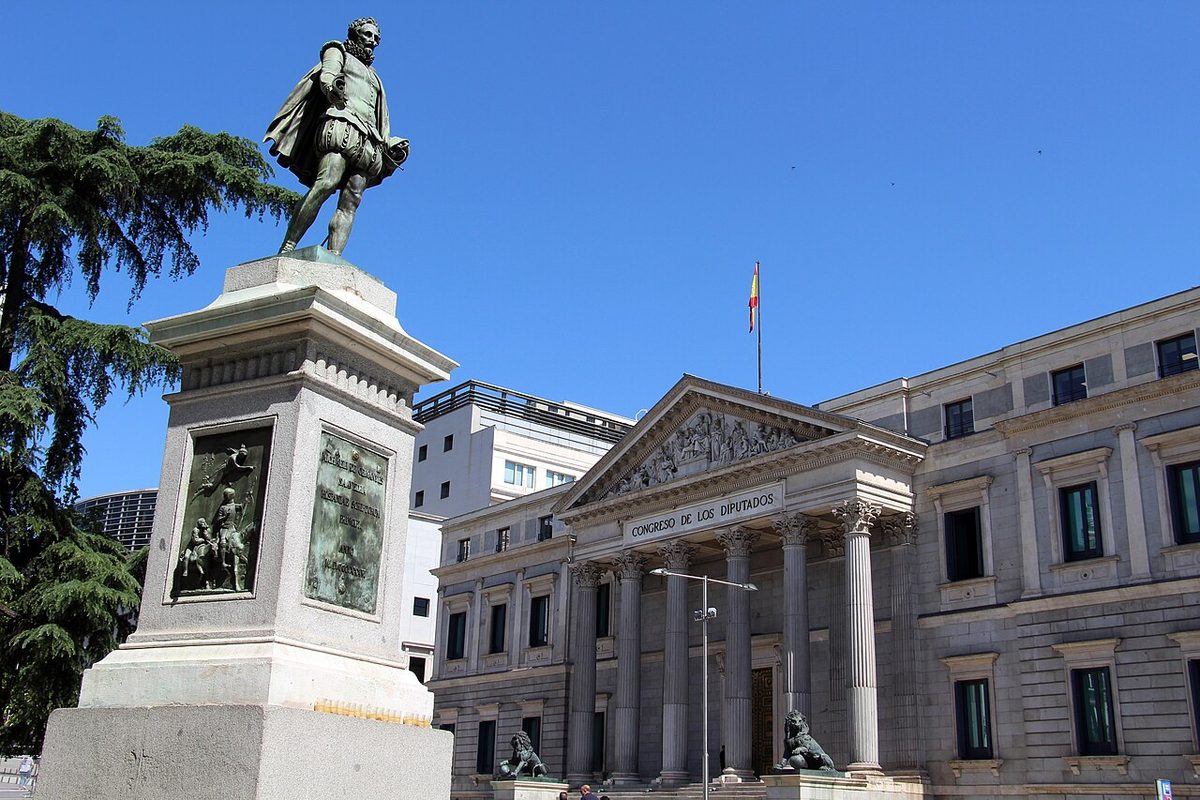
Photo: Fred Romero, CC BY 2.0, via Wikimedia Commons — The Palacio de las Cortes, Madrid, 25 May 2017. The photo is from an earlier date, not the election.
TL;DR — the direct answer: Spain votes on Sunday, 29 November, in a snap general election that could end eight years of Socialist rule under Prime Minister Pedro Sanchez and hand power to a coalition of the conservative People's Party and the far-right Vox. Practically every opinion poll points to the same outcome: the People's Party and Vox together winning an absolute majority in the 350-seat Congress of Deputies, the only combination likely to reach the 176 seats needed to govern. The final 40dB poll put the People's Party at 31.8 percent, the Socialists at 30.9 percent and Vox at 17.3 percent, giving the right 187 seats. Sanchez called the election on 5 October, three days after Congress rejected two government housing decrees, in a gamble that the housing protests sweeping Spain would carry the left to victory. The gamble appears to be falling short, but Sanchez has been written off before: in 2023 the same polls had him losing, and he stayed in office. Polls close at 8pm Spain time, and the provisional result is usually clear the same night, though forming a government could take weeks.
| Metric / Date | Key Detail | Source |
|---|---|---|
| 29 Nov 2026 | Snap general election: all 350 Congress seats contested; 176 needed for an absolute majority | The Straits Times |
| 31.8% vs 30.9% | Final 40dB poll: PP 31.8%, PSOE 30.9%, Vox 17.3%; the People's Party and Vox projected at 187 seats | The Private Banker |
| 5 Oct 2026 | Sanchez called the vote three days after Congress rejected two housing decrees on 2 October | The Private Banker |
| 23 Dec 2026 | The new lower house meets on 23 December to elect a speaker; King Felipe then nominates a candidate for premier | The Straits Times |
| 38.7 million | 38.7 million eligible voters, including nearly 2.8 million abroad; over 1.6 million have turned 18 since 2023 | The Private Banker |
Spain holds a snap general election on Sunday, 29 November, nine months earlier than scheduled, in a vote that could replace the Socialist-led minority government of Prime Minister Pedro Sanchez with a right-wing coalition. The formal campaign closed on Friday, with Sanchez in Madrid, Feijoo in Seville and Abascal in Valencia. Practically all opinion polls point to a potential coalition between the conservative People's Party and far-right Vox as the only combination likely to win an absolute majority in the 350-seat lower house of parliament. The People's Party is seen as the largest party at around 31 percent, while Vox stands at roughly 18 percent, propelled by younger and male voters, pollsters predict. Despite a recent modest rise to almost 30 percent, Sanchez's Socialist Party, the PSOE, is mostly expected to come a close second. Parties further to the left, which would be key for a coalition, are jointly polling at around 10 percent. Two seat forecasts published on 23 November, the last day polls could legally appear before a blackout, put the right and far right at 187 to 189 of the 350 seats. A majority requires 176. The final 40dB survey, based on 7,500 interviews from 10 to 21 November, put the People's Party at 31.8 percent, the Socialists at 30.9 percent and Vox at 17.3 percent, giving the right 187 seats. The state-run CIS is the outlier, with the Socialists first at 33.3 percent. A final pre-election poll found 66 percent of respondents gave Sanchez a failing grade, against 29.5 percent who passed him. Turnout is expected above 70 percent, and Sanchez has argued that turnout near 75 percent would help the left. There are 38.7 million eligible voters, including nearly 2.8 million abroad.
The election is trending because it could put a far-right party into Spain's central government for the first time since the death of Francisco Franco in 1975. A coalition of the People's Party and Vox would give Vox, led by Santiago Abascal, a cabinet role, and Abascal has set three conditions for a deal: national priority for Spaniards in public aid, remigration, and tax cuts with deregulation. He says Vox wants to lead a government, not hold a vice presidency. The two parties have already struck such pacts to govern three regions this year, and Vox has taken seats in two regional governments. The vote is also a verdict on Sanchez, one of Europe's last leftist leaders, after eight years in office. He called the election on 5 October, three days after Congress rejected two government housing decrees, in an attempt to harness the momentum of housing protests and repair political damage from a migration crisis in Spain's North African enclave of Ceuta, a deadly train crash in January and corruption probes involving his inner circle. Another train crash followed on 28 October, when a high-speed train hit a stationary train near Urda, killing 69 people. One toll needs flagging: the site's own earlier Urda article put the identified dead at 66, while PredictIt reports 69, and this article uses 69. Transport Minister Oscar Puente resigned on 3 November and dropped out of the election. It was Spain's second deadly crash this year, after a January derailment in Andalusia killed 46. The housing issue that triggered the election has only grown. Average rent in Spain has almost doubled in a decade, and in October a 50-square-metre apartment in Madrid averaged 1,170 euros a month, nearly half the average gross salary. Protests grew after an 87-year-old woman, Maricarmen Abascal, died two weeks after being evicted from her Madrid apartment in September, when her rent had been raised to 1,650 euros from 570 euros. On 11 November, Spain's two biggest unions held the country's first general strike in 14 years over housing and wages. Consumer prices rose 4.9 percent in the year to October, against 4 percent for the euro zone, and days before the vote the government approved 1.21 billion euros to extend transport discounts through 2027, along with a general pay increase of up to 4.5 percent for 2027.
Sanchez has been written off before, and that history is the reason nobody in Madrid is calling the result yet. In 2016, his own party pushed him out as its leader. He won the job back the next year, and in 2018 he became prime minister by toppling his predecessor in a no-confidence vote. In 2023, most polls had the People's Party and Vox on course to replace him. They came up six seats short, and he stayed. The People's Party did finish first, with 137 seats, but Vox fell to 33, and together they had 170, six short of a majority. Feijoo went to Congress first and lost twice in September 2023, and Sanchez then stitched together 179 votes from Sumar and six regional parties, including Junts, which he won over with an amnesty for Catalan separatists. Congress confirmed him on 16 November 2023, 116 days after the vote. His path this time is harder. The Catalan separatist party Junts, which put him over the top last time, broke with him in 2025, with 87 percent of its members voting to break with the Socialists, and Junts joined the People's Party and Vox on 2 October to vote down Sanchez's housing decrees. Junts also rules out backing Feijoo, and it could hold the balance if nobody reaches 176. The left is also split. Parties to the PSOE's left failed to agree on a common candidate list, and Spain's electoral system disadvantages smaller parties running separately. The Broad Front is polling at 3.7 percent and five seats, Sumar is projected to split, and Podemos is on course for no seats where it runs alone. Some details cut against the narrative of a government in decline: Spain's economy grew 2.7 percent from a year earlier in the third quarter, more than twice the 1.3 percent pace of the euro zone. Sanchez has also clashed with President Donald Trump over NATO spending, Gaza and Spain's refusal to let US forces use its bases for operations in the Iran War. At a rally in Tenerife on 21 November he asked what good Trump had brought the United States and the world. A People's Party government is expected to move closer to Washington, and neither major party has committed to NATO's target of 5 percent of GDP for defence. The election also carries a foreign-policy edge for the left: Sanchez has been one of Europe's loudest advocates of immigration's benefits for the economy, while Vox wants far tighter controls, and the campaign has been fought over housing, immigration and corruption in roughly equal measure. Opposition parties made corruption a central theme after convictions involving members of Sanchez's inner circle and family, though they failed to tie Sanchez to the scandals, and he has repeatedly denied any wrongdoing. His wife, Begona Gomez, is awaiting trial on corruption charges, which she denies.
Confirmed: Spain votes on Sunday, 29 November, in a snap general election, with all 350 lower-house seats contested on closed party lists and 176 needed for a majority; Sanchez called the vote on 5 October, three days after Congress rejected two housing decrees on 2 October; the final published polls point to a combined majority for the People's Party and Vox, with the 40dB survey putting the People's Party at 31.8 percent, the Socialists at 30.9 percent and Vox at 17.3 percent, and the right at 187 seats; the El Pais average has the People's Party at 31.4 percent, the Socialists at 29.1 percent and Vox at 17.9 percent; the People's Party is led by Alberto Nunez Feijoo, 65, who has led the party since April 2022 and was formerly president of Galicia; Sanchez, PSOE leader since 2017, is the second-longest-serving premier since Spain's return to democracy in 1978; the new lower house meets on 23 December to elect a speaker, after which King Felipe nominates a candidate for premier; and polls close at 8pm Spain time, with the provisional result usually clear the same night. Three details need flagging. First, the polls disagree: the 40dB and El Pais figures point to a right-wing majority, while the state-run CIS has the Socialists first at 33.3 percent, and this article gives all three, treating the CIS as the outlier. Second, the Urda death toll: PredictIt reports 69 people died in the 28 October crash, while the site's own earlier article put the identified dead at 66, and this article uses 69. Third, the seat forecasts: two forecasts published on 23 November put the right at 187 to 189 seats, while the final polling average puts the People's Party at 128 seats including its UPN alliance, and the two measures are not the same thing. What remains unconfirmed is the result itself. Simulation work on the final polling data suggests the right's lead is not fragile: across 20,000 simulations, the People's Party and Vox reached an absolute majority in about 90 percent of runs, even with polling errors 25 percent larger than in general elections from 2008 to 2023. But the polls said the same thing in 2023, and Sanchez still won a new term 116 days after the vote. It is also unclear whether Feijoo could become prime minister with Vox's backing even if the Socialists finish first in the popular vote, and whether a hung Congress would mean weeks of coalition talks or a repeat election.
Polls close at 8pm Spain time on Sunday, and Spain counts fast, so the provisional result is usually clear the same night. The harder question, who can get to 176 in Congress, can take much longer. The new lower house meets on 23 December and elects a speaker. King Felipe will then nominate a candidate for the premiership, usually the leader of the party with the most votes. The nominee needs an absolute majority of at least 176 seats in the investiture vote, or a simple majority in a second round 48 hours later. Coalition talks have no deadline, but a new government must be formed within two months of that vote to avoid another election. If the polls are right, Feijoo will go first, with Vox's backing, and Abascal's three conditions, national priority for Spaniards in public aid, remigration, and tax cuts with deregulation, will be the price of the deal. If neither bloc reaches a workable majority, Spain could face weeks of coalition talks or a repeat election, and Junts, which rules out backing Feijoo, could hold the balance. Sanchez stays on as acting prime minister until Congress confirms a successor: after the 2023 election it took 116 days, and in 2016 and 2019 Spain had to vote again. A People's Party government is expected to move closer to Washington, including on the use of Spanish bases for strikes on Iran, which Sanchez refused, and on NATO spending, where neither major party has committed to the 5 percent of GDP target.
Q: When does Spain vote, and when do polls close?
A: Spain votes on Sunday, 29 November 2026, in a snap general election. Polls close at 8pm Spain time, 2pm ET, and an hour later in the Canary Islands. Spain counts fast, and the provisional result is usually clear the same night, though forming a government can take much longer.
Q: How many seats does it take to govern Spain?
A: A prime minister needs 176 of the 350 seats in the Congress of Deputies for an absolute majority on the first investiture vote. If that fails, a second vote 48 hours later needs only more yes votes than no. If no candidate is confirmed within two months of the first vote, Spain holds a new election.
Q: Who is ahead in the polls?
A: Practically every poll points to a combined majority for the People's Party and the far-right Vox. The final 40dB survey put the People's Party at 31.8 percent, the Socialists at 30.9 percent and Vox at 17.3 percent, giving the right 187 seats. The state-run CIS is the outlier, with the Socialists first at 33.3 percent.
Q: Why did Pedro Sanchez call a snap election?
A: Sanchez called the vote on 5 October, three days after Congress rejected two government housing decrees aimed at rising rents and evictions. He hoped to harness the momentum of housing protests and repair damage from a migration crisis in Ceuta, a deadly train crash in January and corruption probes involving his inner circle. A second train crash followed on 28 October.
Q: What would a People's Party and Vox government mean?
A: It would give a far-right party a cabinet role for the first time since the death of Francisco Franco in 1975. Vox leader Santiago Abascal has set three conditions for a deal: national priority for Spaniards in public aid, remigration, and tax cuts with deregulation. The party wants to lead a government, not hold a vice presidency, and a People's Party government is expected to move closer to Washington.
Sources: The Straits Times — Explainer: Spain's snap election, why it matters and who might win, Times Now — Spain Elections 2026: Pedro Sanchez Fights To Hold On As Right Wing PP-Vox Coalition Looms, The Private Banker — Spain Votes Sunday With Final Polls Pointing to a PP-Vox Majority, and PredictIt — Can Spain's Sanchez Pull Off Another Comeback?.

Spain staged its first general strike in 14 years on 11 November, as unions and tenants protested a housing crisis before a snap election on 29 November.

By Toijam Bimoljit Singh · Thu, 12 Nov 2026

Spanish authorities have now identified 66 of the 69 people killed in the high-speed train collision near Urda, in central Spain, on 28 October 2026.
By Toijam Bimoljit Singh · Mon, 2 Nov 2026

Focker In-Law took $7.7 million on Thanksgiving Day for second place, behind the Hunger Games prequel's $11.6 million, as Ariana Grande joined the cast.
By Toijam Bimoljit Singh · Sat, 28 Nov 2026
The day’s biggest stories in your inbox every morning — free, no spam, unsubscribe anytime.